
PLI 2.0 for IT Hardware
The Production Linked Incentive (PLI) 2.0 scheme for IT hardware is a major initiative by the Government of India designed to establish the nation as a global hub for Electronics System Design and Manufacturing (ESDM). Housed under the Ministry of Electronics and Information Technology (MeitY), the scheme builds heavily on the lessons of its 2021 predecessor by offering significantly improved flexibility, larger budgetary layout and deeper domestic vertical integration.
Why in the News?
Government recently approves 27 manufacturers under PLI Scheme – 2.0 For IT Hardware.
Quick Facts
Purpose: To boost domestic manufacturing and attract large investments in the value chain
Type: Central Sector Schemes
Incentive Period: 6 years during Scheme Tenure
Project Management Agency: Industrial Finance Corporation of India (IFCI)
Objective
Through financial incentives boost domestic manufacturing and attract large investments in the value chain.
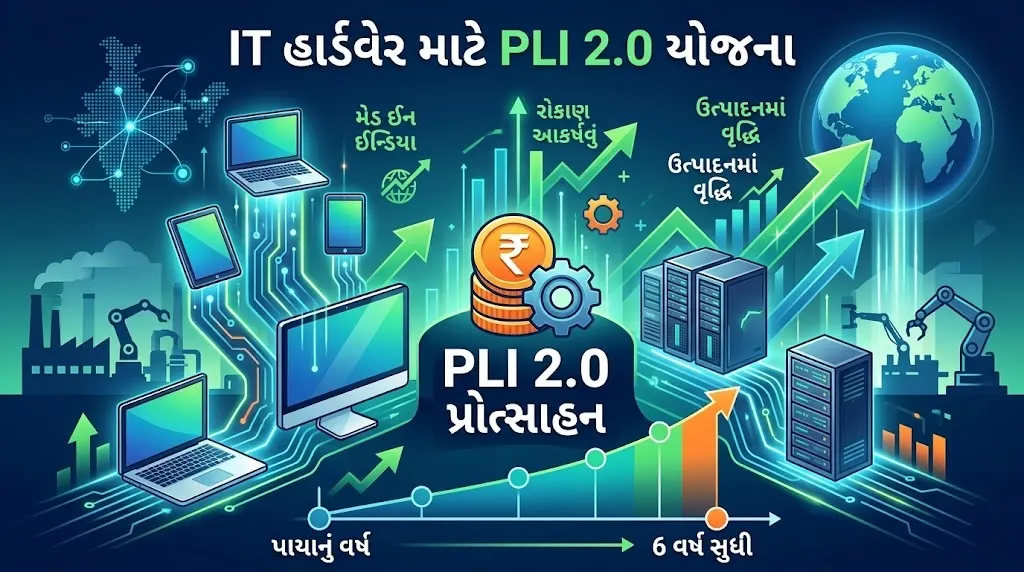
Salient Features :
Background:
PLI 2.0 Scheme for IT hardware doubled the outlay while also enhancing the incentive and tenure as compared to PLI 1. 0 (launched in 2021).
It was launched to provide more flexibility to applicants and allow a longer duration to develop the supply chain within the country
3 category of applicants:
Global companies
Hybrid (global/domestic) companies
Domestic companies.
PLI 2.0 for IT Hardware Target Segment:
Laptops, Tablets
All in-One PCs
Servers
Ultra Small Form Factor (USFF)
Semiconductor design,
IC manufacturing, and
packaging are included as incentivized components of PLI 2.0.
Eligible Product:
Goods manufactured in India and covered under target segment. Incentive shall given on the sales of Target Segment Goods.
Incentives:
Around 5% on net incremental sales over base year.
Monitoring:
Empowered Group of Secretaries (EGoS) chaired by the Cabinet Secretary
Production Linked Incentive 2.0 IT hardware,
PLI Scheme 2.0 approved manufacturers,
MeitY semiconductor design incentives,
IT hardware manufacturing India.
Strategic Adjustments: How PLI 2.0 Differs from 1.0
The revised layout specifically formulated address structural supply chain gaps:
Increased Flexibility:
Applicants are granted a longer,
staggered duration to systematically build up local component supply chains inside the country rather than relying on immediate localization.
Localized Component Multiplication:
Additional localized multipliers are introduced when manufacturers source
high-value components
(like bare PCBs, memory modules, or power adapters) domestically.
Import Substitution:
By incentivizing domestic server and laptop production lines, the framework directly reduces fiscal dependency on foreign Original Equipment Manufacturers (OEMs).
Digital India Programme Details: Expansion Outlay & Core Visions


Pingback: PM Jan Dhan Yojana (PMJDY): Benefits, Overdraft & Insurance