
REGIONAL CONNECTIVITY SCHEME (RCS)
Why in the News?
Comptroller and Auditor General’s (CAG) Audit report on the Regional Connectivity Scheme – UDAN was laid down in both houses of the Parliament.
Quick Facts
Purpose: To enable air operations on underserved / unserved routes, promote balanced regional growth and make flying affordable for masses
Type: Central Sector Schemes
Support to airlines: In the form of Concessions and Viability Gap Funding (VGF)
Tenure: 10 years
Objective
To fulfil the aspirations of the common citizen with an enhanced aviation infrastructure and air connectivity in tier II and tier III cities.
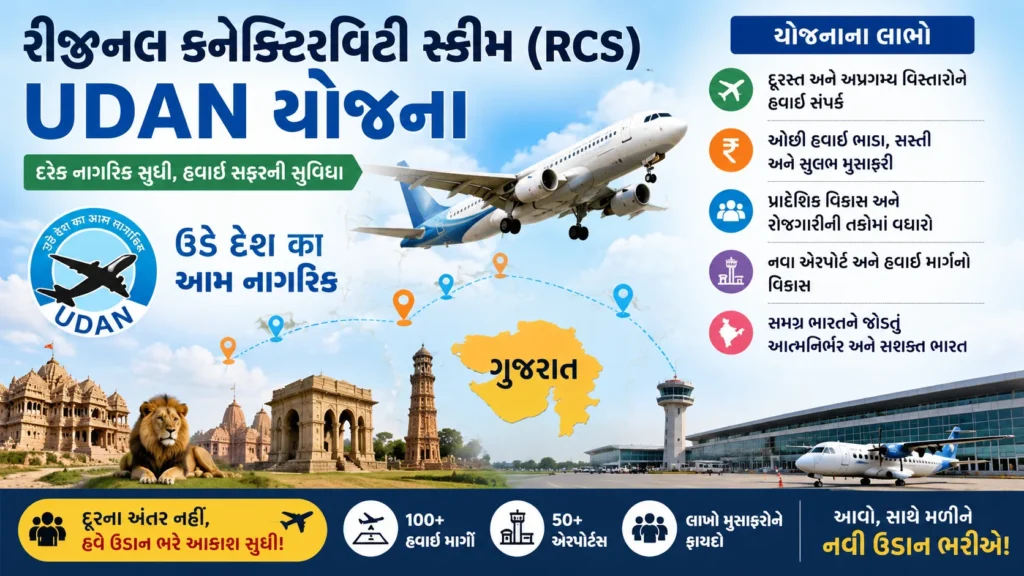
Salient Features
Background:
Launched under National Civil Aviation Policy (NCAP) 2016.
NCAP envisaged Regional Connectivity Scheme (RCS) to enhance regional air connectivity through fiscal support and infrastructure development.
UDAN is designed to enable air operations on underserved / unserved routes connecting regional areas,
promote balanced regional growth and make flying affordable for masses.
Subsidised seats
Airfare is capped at Rs. 2500 for a distance of 500 km to 600 km per seat. However, the capping is subject to indexation as per the formula specified in the UDAN Scheme document.
Airlines have to provide 50% of the seats (9- 40 Seats) at subsidized rates.
Regional Connectivity Fund (RCF):
It facilitates the self-financing mechanism of the scheme by funding the VGF through a levy on certain domestic flights.
Demand and market-based model:
RCS is available only in States and at airports/aerodromes/helipads which provide concessions.
State governments have to provide free security & fire service, utilities at concessional rates, free land for RCS airports etc.
Support to airlines:
Centre shares 80% of the VGF, and rest 20% comes from the respective state governments (NE states, UK, HP and UTs will contribute 10%).
Flexibility for Identification of Routes:
Airline operators propose regional routes they wish to operate and apply for Viability Gap Funding (VGF).

Pingback: BharatNet Project Details - Indian Advocacy